
Technology
How a 3D pen is built
Four things worth knowing before a pen reaches a child's hands: how it works, how it's protected, what it's certified for, and how the whole range is built.
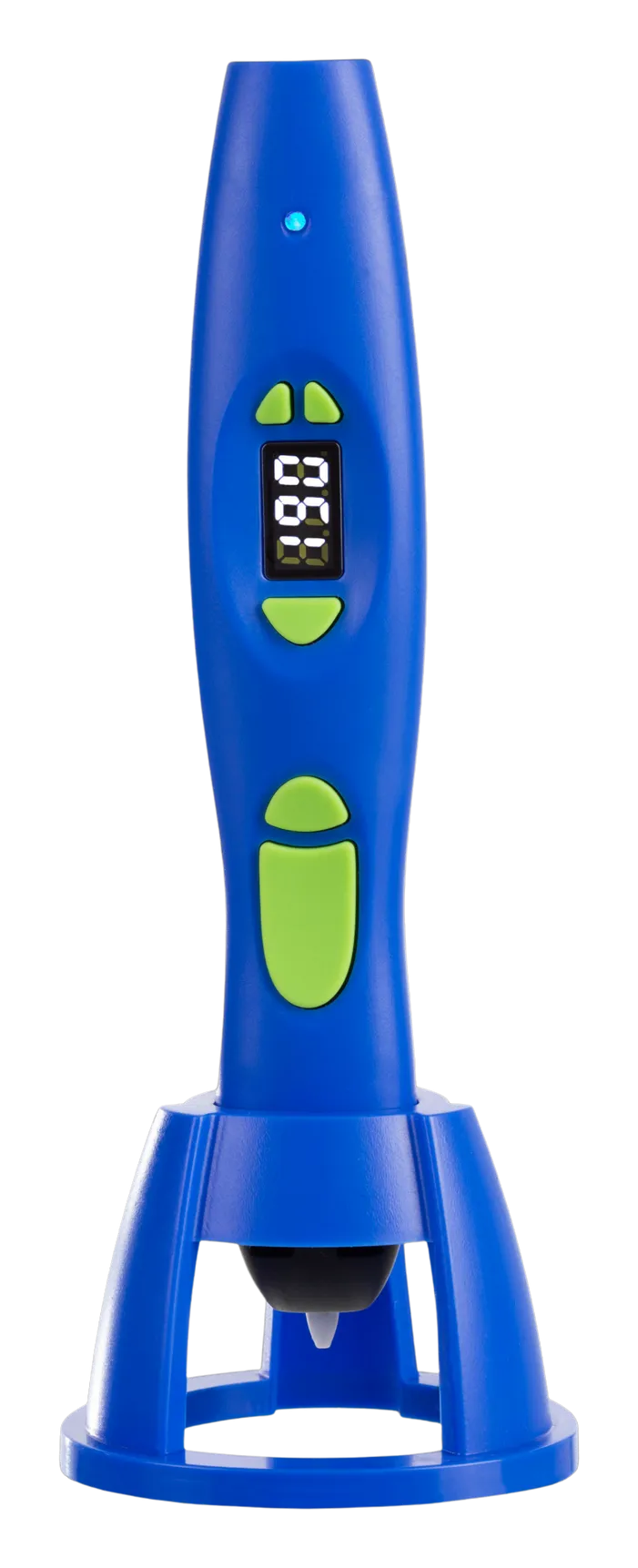
How a 3D pen works
Heat, filament and control over both
A 3D pen heats filament to its melting point and extrudes it through a nozzle, the same way a 3D printer does, just held in a hand. Cooled filament sets within seconds, so a line holds its shape right away.
How a 3D pen works
Adjustable 50-230°C, in 5°C steps
Every material has its own range. Lower temperatures for gentler filaments, higher ones for more demanding work.
Five materials: PLA, PCL, ABS, TPU, PET-G
The pen automatically sets baseline parameters for the loaded material, eliminating errors at the start.
10 speed levels
Slower for precise outlines, faster for filling larger areas.
USB-C power, 5V/2A (10W)
Wired or with a power bank, for up to about 3 hours of cable-free work.
PCL is a low-temperature filament, recommended as a gentler starting point for younger makers.
Child safety
Designed for the smallest hands
A 3D pen runs at high temperature, so safety is part of the build, not an add-on. Three mechanisms work together, and adult supervision stays exactly where it always should: with the child.
Child safety
Parental lock at 90°C
With the lock on, heating is limited to 90°C. Without it, the pen runs its full range up to 230°C, available to older and experienced users.
Auto-sleep after 5 minutes
Left idle, the pen powers itself down instead of heating unattended.
A body designed for a child’s hand
A non-slip finish and a compact build: 64.7 g, drop-tested from 1000 mm.
Adult supervision
Recommended for every session, and required for the youngest makers and for work across the full temperature range.
Recommended for use under adult supervision only, especially for the youngest makers.
Certificates and compliance
Compliance backed by documents
EDUstick® pens and power banks carry separate sets of certificates. Test reports and Declarations of Conformity are available to partners and institutional buyers on request.
- EN 71
- CE
- RoHS
- REACH
- WEEE
- EMC
- LVD
- UKCA
3D pens (SOLO, Co-LAB)
Warranty: 24 months
- EN 71
- CE
- RoHS
- REACH
- WEEE
- EMC
- LVD
Power banks and charging station
Warranty: 12 months
- CE
- RoHS
- UKCA
Modular architecture
Pen and drive unit: two products, one system
EDUstick® SOLO and EDUstick® Co-LAB share a common architecture component: an external drive unit, also sold as its own standalone product. The pen and the drive are two separate, interchangeable parts: when the drive wears out, only that gets replaced, and the pen stays in place. The EDUstick® family grows on this shared foundation.
3D pen
External drive unit
Two separate, interchangeable products. You attach the drive unit when you need it and detach it without tools.